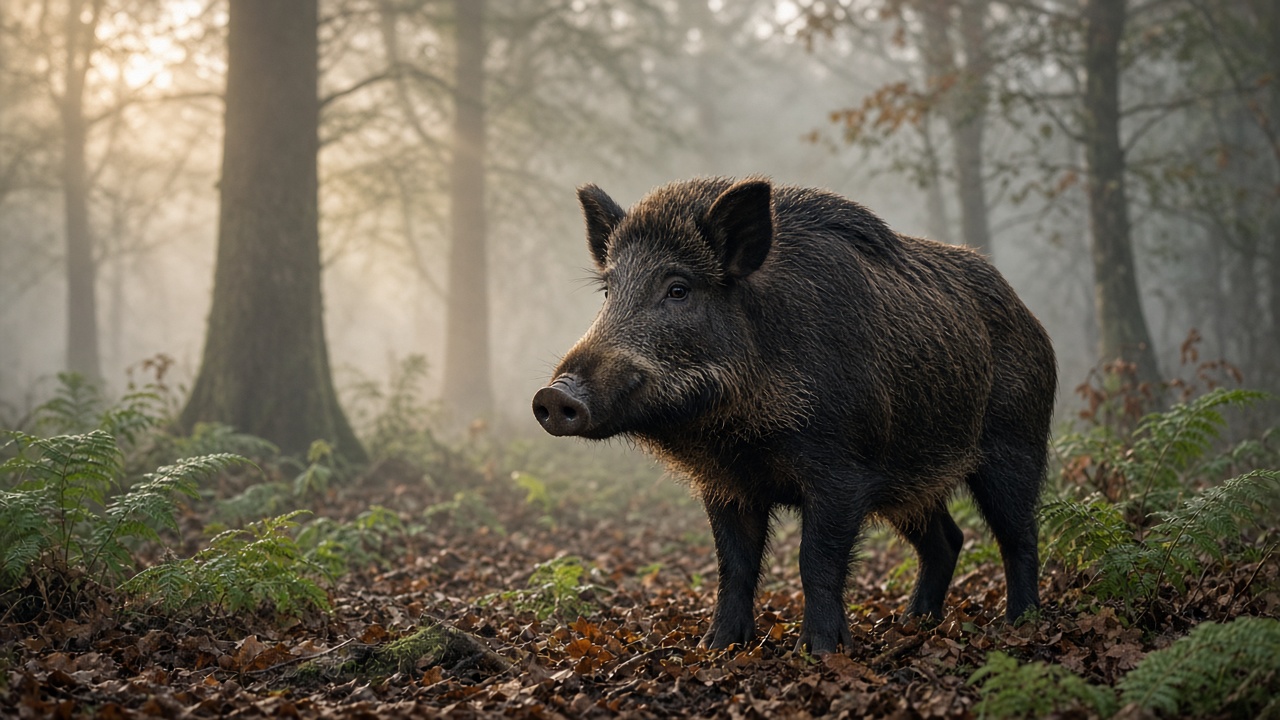
Eurasian Wild Pig
Sus scrofaEurasian Wild Pig (Sus scrofa): biology, habitats and field signs across its documented range, hunting-context reading.
Seen in: Argentina · Australia · Austria · Belgium · Brazil
Overview
Eurasian Wild Pig (Sus scrofa) is presented here in a hunting-context reading across its documented range: biology, habitats and field signs useful to observers — without publishing season, quota or authorisation.
Classification: order Artiodactyla, family Suidae, genus Sus. Common names: Eurasian Wild Pig in English, Sanglier in French, Jabalí in Spanish.
Identification
Adult wild boar measure 153 to 240 cm in total length and weigh 66 to 272 kg; females are smaller than males, and the gap widens with age. Bulky at the front, they can stand 0.9 m at the shoulder and taper towards the hindquarters. The thick, coarse coat ranges from black to reddish-brown or even white, plain or speckled depending on the region, sometimes with a crest of bristles along the back. The upper canines, 5 to 10 cm long, show even when the mouth is closed. Piglets have yellowish-brown stripes that fade at about 4 months.
An omnivore, it eats mostly plant matter: crops, fruit, nuts (mast), roots and green plants, but also birds’ eggs, carrion, small rodents, insects and worms; it forages mainly in the evening and at night. Females live in sounders of 6 to 20 related sows, sometimes over 100 animals; males leave at 1 to 2 years and rejoin only for the rut. Breeding depends on food supply: after 108 to 120 days of gestation, 5 to 6 piglets are born on average, with up to two litters a year.
Habitats and range
MDD lists it in North Africa (Morocco, Algeria, Tunisia), throughout mainland Europe to the Caucasus and western Russia, and across much of Asia to Japan, Sri Lanka and Indonesia; extinct in Ireland, Scandinavia and the United Kingdom, it has been reintroduced to England, southern Finland and southern Sweden, and was anciently introduced to Corsica and Sardinia. It uses forest, grassland, farmland, scrub and marsh, provided it has water and dense cover nearby.
The countries where the species’ presence is established are shown in the tags on this sheet.
Field signs
In hot weather it wallows in water and mud, which cools it and rids it of parasites. Rooting for food, it turns over soil and low vegetation. Before giving birth, the sow builds a nest of broken or uprooted saplings. It rubs on the ground, leaving scent traces, growls when aggressive and squeals. Sounders travel with the piglets kept in the middle.
Conservation
For conservation status of Sus scrofa, consult the current IUCN assessment, then cross with French monitoring programmes when they exist (OFB portal and related publications). Never turn a global IUCN category into a departmental hunting rule. GBIF occurrences help situate documented distribution but remain effort-biased.
The IUCN lists it as Least Concern. Where introduced, as in the south-eastern United States or the Galápagos, it is invasive and harms native plants and animals. It hosts parasites that can pass to people and livestock, such as Trichinella and Toxoplasma gondii. MDD treats it as the wild form of the domestic pig and includes several Asian forms, such as cristatus, vittatus and ussuricus, that Groves and Grubb (2011) ranked as species.
Limits
This sheet on the Eurasian Wild Pig publishes no season, quota, hunting method or fee: those rules differ between countries and territories and must be checked in official texts. Being described here does not mean a species may be hunted.
Local densities and management plans are not covered here: they are a matter for the managers of each area.
Sources
Sources consulted for this sheet:
- IUCN Red List — species search (consulted 2026-11-01)
- ASM Mammal Diversity Database — Sus scrofa (consulted 2026-11-01)
- GBIF — species search (consulted 2026-11-01)
- Animal Diversity Web — Sus scrofa (wild boar) (consulted 2026-11-04)
Conclusion
In short: use the scientific name Sus scrofa to cross-check sources, confirm taxonomy and conservation status on the institutional portals listed above, and relate every field sign to the habitat where it was actually found.
Identification
Sus scrofa
Sanglier · preferred
Jabalí · preferred
Eurasian Wild Pig · preferred
Wild Boar
Indochinese Pig
Indonesian Banded Pig
Classification
Class : Mammalia
Order : Artiodactyla
Family : Suidae
Genus : Sus
Conservation
IUCN : LC
CITES : —
iucn · LC (global)
Habitat
Practices
Frequently asked questions
How do I recognise Eurasian Wild Pig?
Use Sus scrofa as the scientific anchor. Adult wild boar measure 153 to 240 cm in total length and weigh 66 to 272 kg; females are smaller than males, and the gap widens with age. Bulky at the front, they can stand 0.9 m at the shoulder and taper towards the hindquarters. The thick, coarse coat ranges from black to redd...
Where does Eurasian Wild Pig typically live?
MDD lists it in North Africa (Morocco, Algeria, Tunisia), throughout mainland Europe to the Caucasus and western Russia, and across much of Asia to Japan, Sri Lanka and Indonesia; extinct in Ireland, Scandinavia and the United Kingdom, it has been reintroduced to England, southern Finland and southern Sweden, and was anciently introduced to Corsica and Sardi...
What field signs help confirm Eurasian Wild Pig?
In hot weather it wallows in water and mud, which cools it and rids it of parasites. Rooting for food, it turns over soil and low vegetation. Before giving birth, the sow builds a nest of broken or uprooted saplings. It rubs on the ground, leaving scent traces, growls when aggressive and squeals. Sounders travel with the piglets kept in the middle.