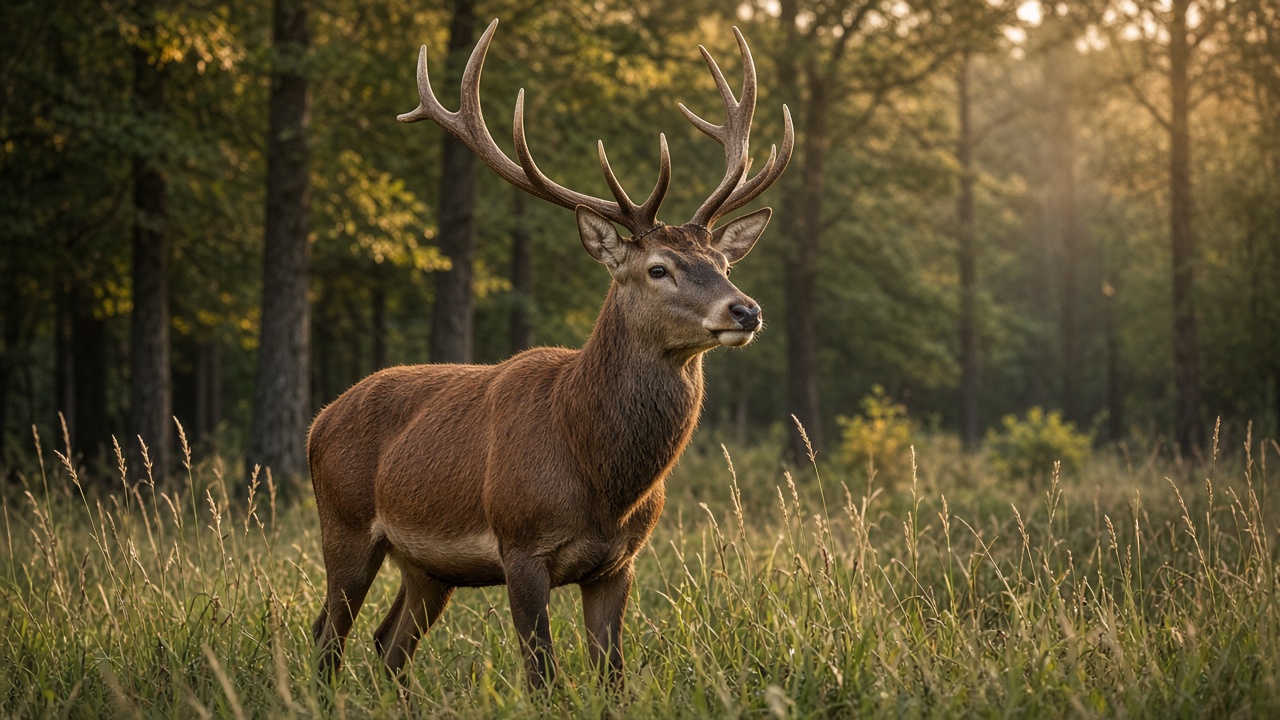
Western Red Deer
Cervus elaphusWestern Red Deer (Cervus elaphus): biology, habitats and field signs across its documented range, hunting-context reading.
Seen in: Argentina · Australia · Austria · Belgium · Bulgaria
Overview
Western Red Deer (Cervus elaphus) is presented here in a hunting-context reading across its documented range: biology, habitats and field signs useful to observers — without publishing season, quota or authorisation.
Classification: order Artiodactyla, family Cervidae, genus Cervus. Common names: Western Red Deer in English, Cerf élaphe in French, Ciervo rojo in Spanish.
Identification
The red deer is one of the largest deer species; according to the British Deer Society, hinds weigh 63 to 120 kg, and animals living in open upland habitats tend to be smaller than those of wooded lowlands. The coat is a distinctive rusty red in summer and turns brown in winter; adults are not spotted. The tail is short and the rump patch pale, with no particular markings; the head is large, with wide-set brown eyes. Only stags carry antlers, highly branched and gaining points with age; the brow tine leaves the main beam at about 90°, unlike in sika deer.
It grazes grasses and dwarf shrubs such as heather and bilberry, taking woody browse like tree shoots in winter, when other food is limited. The rut runs from the end of September to November: stags return to the hinds’ range and compete through roaring, parallel walks and fighting, which turns dangerous only between stags of similar size. In woodland, usually only stags over five years old mate. Hinds over one year old give birth to a single calf after an eight-month gestation, between mid-May and mid-July; hill hinds may calve only every two or three years.
Habitats and range
MDD gives the red deer in the strict sense Great Britain and continental Europe, the Atlas Mountains (Algeria, Tunisia), Anatolia, the Caucasus and north-western Iran, with many introductions elsewhere; its country list includes France, Spain and Portugal. It prefers woodland and forest but adapts to open moor and hills, as in Scotland and south-west England. In the Scottish Highlands it uses the open hills by day and descends to lower ground at night.
The countries where the species’ presence is established are shown in the tags on this sheet.
Field signs
Its hoof prints, or slots, are large and can be confused with those of sheep or goats; a stag’s front hoof may measure 8 to 9 cm. During the rut stags roar and grunt; hinds bark when alarmed and moo when searching for their young, while calves squeal when alarmed or bleat to their mother. Active around the clock, it peaks at dawn and dusk. In woodland it is largely solitary or in mother-and-calf groups; on open ground it forms larger single-sex groups that mix only in the rut.
Conservation
For conservation status of Cervus elaphus, consult the current IUCN assessment, then cross with French monitoring programmes when they exist (OFB portal and related publications). Never turn a global IUCN category into a departmental hunting rule. GBIF occurrences help situate documented distribution but remain effort-biased.
MDD gives its IUCN status as Least Concern. MDD includes the forms maral, corsicanus and pannoniensis, which Groves and Grubb (2011) treated as distinct, and notes that the species formerly included C. hanglu and the wapiti, C. canadensis, now separate. In Britain, the British Deer Society reports that Neolithic forest clearance confined it to a few areas; releases of stock sometimes crossed with wapiti followed, and it is now expanding in range and number. Browsing on tree shoots and crops brings it into conflict with farmers and foresters.
Limits
This sheet on the Western Red Deer publishes no season, quota, hunting method or fee: those rules differ between countries and territories and must be checked in official texts. Being described here does not mean a species may be hunted.
Local densities and management plans are not covered here: they are a matter for the managers of each area.
Sources
Sources consulted for this sheet:
- IUCN Red List — species search (consulted 2026-11-01)
- ASM Mammal Diversity Database — Cervus elaphus (consulted 2026-11-01)
- GBIF — species search (consulted 2026-11-01)
- The British Deer Society — Red deer (Cervus elaphus) (consulted 2026-11-05)
Conclusion
In short: use the scientific name Cervus elaphus to cross-check sources, confirm taxonomy and conservation status on the institutional portals listed above, and relate every field sign to the habitat where it was actually found.
Identification
Cervus elaphus
Cerf élaphe · preferred
Ciervo rojo · preferred
Western Red Deer · preferred
Stag
Barbary Red Deer
Bukhara Red Deer
Caspian Red Deer
Maral
Thyrrenian Red Deer
Persian Red Deer
Turkish Red Deer
Mesola Red Deer
Barbary Stag
Central European Red Deer
Common Red Deer
Norwegian Red Deer
Scottish Red Deer
Spanish Red Deer
Corsican Red Deer
Crimean Red Deer
Classification
Class : Mammalia
Order : Artiodactyla
Family : Cervidae
Genus : Cervus
Conservation
IUCN : LC
CITES : —
iucn · LC (global)
Habitat
Practices
Frequently asked questions
How do I recognise Western Red Deer?
Use Cervus elaphus as the scientific anchor. The red deer is one of the largest deer species; according to the British Deer Society, hinds weigh 63 to 120 kg, and animals living in open upland habitats tend to be smaller than those of wooded lowlands. The coat is a distinctive rusty red in summer and turns brown in winter;...
Where does Western Red Deer typically live?
MDD gives the red deer in the strict sense Great Britain and continental Europe, the Atlas Mountains (Algeria, Tunisia), Anatolia, the Caucasus and north-western Iran, with many introductions elsewhere; its country list includes France, Spain and Portugal. It prefers woodland and forest but adapts to open moor and hills, as in Scotland and south-west England...
What field signs help confirm Western Red Deer?
Its hoof prints, or slots, are large and can be confused with those of sheep or goats; a stag’s front hoof may measure 8 to 9 cm. During the rut stags roar and grunt; hinds bark when alarmed and moo when searching for their young, while calves squeal when alarmed or bleat to their mother. Active around the clock, it peaks at dawn and dusk. In woodland it is...