- Family
- Guided safari
- Difficulty
- High: long walks in the heat, standing shots off sticks and discipline within the group
- Organisation
- The client, a professional hunter and one or more trackers
- Key gear
- Zeroed rifle, shooting sticks, binoculars, water, hat, broken-in boots
- Season
- Varies by country, area and species: check with the wildlife authority and the outfitter
- Who it suits
- Fit hunters, confident shooting standing, ready to follow a guide’s instructions
What is the idea behind a walk-and-stalk safari?
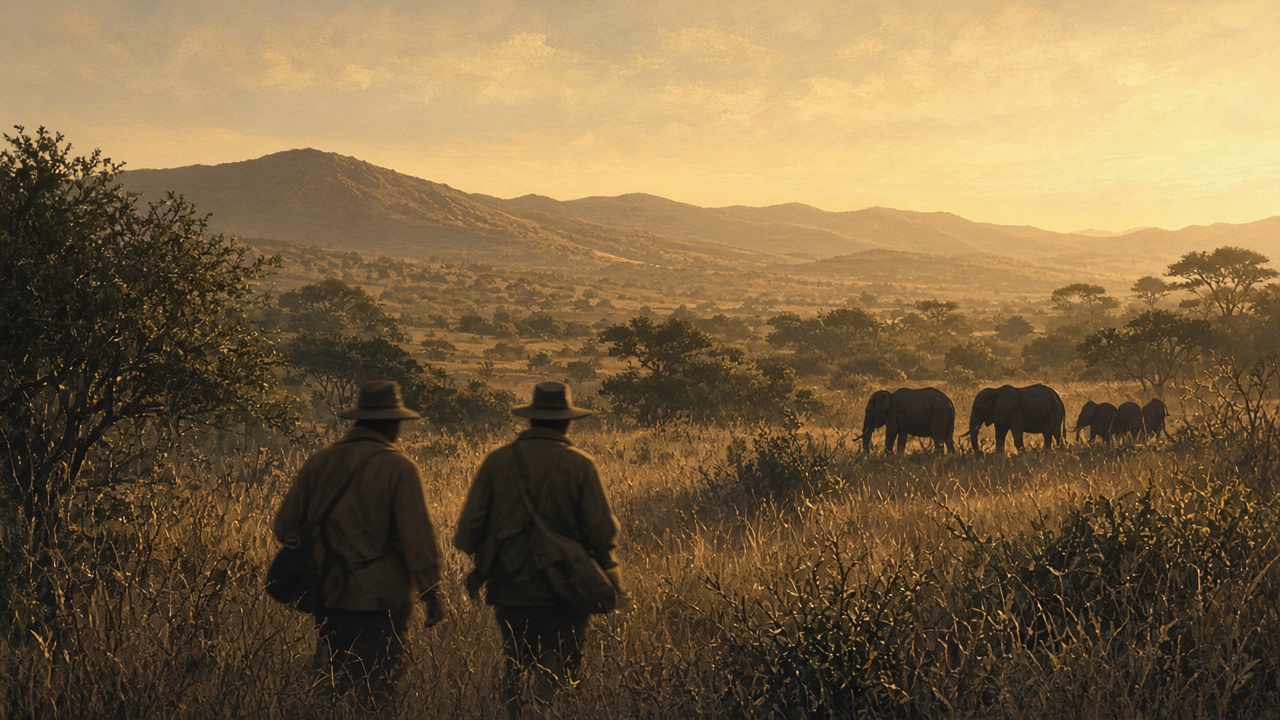
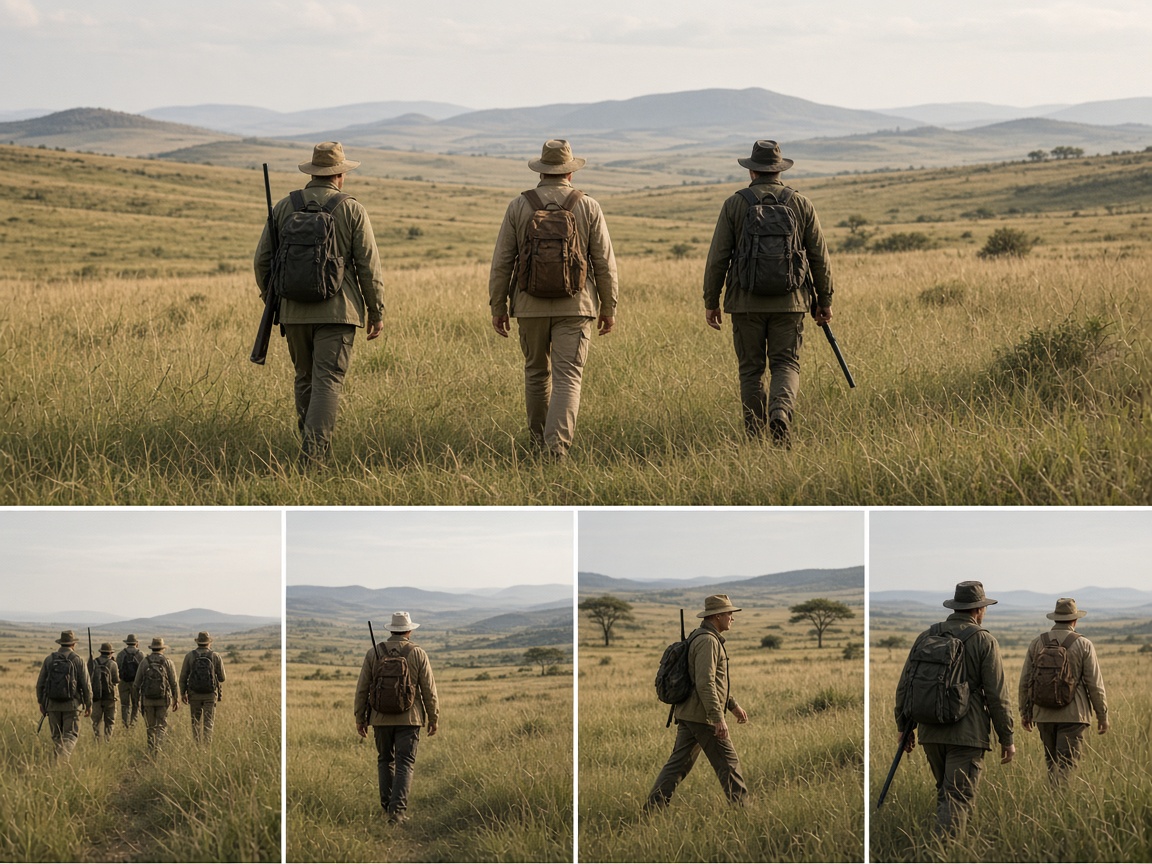
Everything starts with spoor. Trackers read footprints, droppings, flattened grass and broken twigs to tell which animal passed, how long ago and in which direction. The group follows the trail in single file and in silence, the professional hunter just behind the trackers and the client behind them. A vehicle is often used to reach the area or to look for fresh tracks on roads, then the rest is done on foot.
Wind and heat set the pace. The professional hunter checks the air constantly, often with a small bag of powder or ash, and changes the approach as soon as it shifts. Animals move and feed mostly in the cool hours; in the middle of the day they lie up in the shade and the group rests as well. Water, a hat and boots that are already broken in matter as much as the rifle.
The shot is almost always taken standing, off shooting sticks that the tracker or professional hunter sets up at the last moment. The professional hunter confirms the animal and gives the go-ahead. On dangerous game such as buffalo, they stand ready to back up the shot, and each country sets its own requirements on rifles and guiding, which should be checked with the wildlife authority and the outfitter.
How does a walk-and-stalk safari work in the field?
What equipment do you need for a walk-and-stalk safari?
- Shooting sticks, often a tripod, that you have practised with before leaving
- A water bottle or hydration pack, a hat and sun protection
- Light, broken-in boots suited to long walks on hard, thorny ground
- Neutral-coloured clothing for midday heat and cold mornings
Safety rules for a walk-and-stalk safari
- Stay in file and in your given place, never moving ahead of the professional hunter or the trackers
- Chamber a round only when about to shoot, and unload as soon as the professional hunter asks
- Drink regularly and report any sign of heat exhaustion
- The professional hunter decides on the shot; the client fires only with their agreement
Common mistakes in a walk-and-stalk safari
- Talking or making noise during the follow-up, which alerts animals
- Shooting too quickly without waiting for the professional hunter to confirm the animal
- Underestimating the fatigue of a long follow-up and setting off without enough water
- Arriving without having practised off shooting sticks
Which species are hunted by a walk-and-stalk safari?
Where is a walk-and-stalk safari practised?
Namibia
In Namibia, trophy hunting takes place under a permit from the Ministry of Environment (MEFT) issued under the Nature Conservation Ordinance of 1975. The regulations require the trophy hunter to be accompanied by a registered professional hunter, master hunting guide or hunting guide, or by a bow hunting guide when hunting with a bow.
South Africa
In South Africa, the national Threatened or Protected Species (TOPS) Regulations, made under NEMBA, require a non-resident hunting client to be accompanied by a professional hunter when hunting a listed species. Both the professional hunter and the hunting outfitter must hold a provincial licence, and permits and other conditions are a provincial matter.
Limpopo (South Africa)
In Limpopo province, the 2003 provincial Environmental Management Act allows a foreign client to hunt only if the hunt is organised by a licensed hunting outfitter and carried out under the supervision of a professional hunter. The client must follow their lawful instructions.
Tanzania
In Tanzania, hunting takes place in hunting blocks allocated to operators, often in vast, little-developed areas where dangerous game is present. TAWA, the wildlife management authority, administers these blocks and the conditions for hunting.
Rules vary by country and region: check with the local authority. See the sources
A walk-and-stalk safari compared with neighbouring techniques
A walk-and-stalk safari applies the principle of stalking, but on tracks that may be followed for a long time and as a team, with a professional hunter and trackers. Iberian rececho relies mostly on glassing in the mountains, whereas a walk-and-stalk safari relies on reading spoor. A plains-game safari is the type of trip built around antelope in South Africa, which may include days on foot among other methods.
Regional forms of a walk-and-stalk safari
- Plains-game safari A plains-game safari is an organised hunting trip in South Africa built around antelope and other non-dangerous species, such as impala, springbok, kudu, gemsbok, blue wildebeest and warthog.
Key terms in a walk-and-stalk safari
- professional hunter (PH)
- A licensed guide who runs the hunt and is responsible for the client in the field.
- tracker
- A team member who reads spoor and follows the animal with the professional hunter.
- shooting sticks
- A stick, bipod or tripod used as a rest for the rifle when shooting standing or sitting.
- dangerous game
- In Africa, large animals able to injure or kill a hunter, such as buffalo, whose hunting is subject to specific requirements.
- concession
- An area allocated by the state or a landowner to an operator who runs hunting there.
Frequently asked questions about a walk-and-stalk safari
What is a walk-and-stalk safari?
It is African hunting in which you follow an animal’s tracks on foot with a professional hunter and trackers until you can take a safe shot, usually standing off shooting sticks.
What does the professional hunter do?
They run the hunt, judge the animal, decide on the approach and give the go-ahead to shoot. They are responsible for the client’s safety and step in if a wounded or dangerous animal becomes a threat.
What do trackers do?
They read footprints, droppings and vegetation to follow the animal, often on ground where an untrained eye sees nothing. They also set up the shooting sticks and help follow up a shot animal.
Can buffalo be hunted on foot?
Yes, that is the usual way. As buffalo are dangerous game, each country sets its own requirements on rifles and guiding; the outfitter and the wildlife authority explain them.
How do you bring a trophy home?
Depending on the species, export and import may fall under CITES and the animal health rules of the destination country. Check these formalities before leaving with the outfitter and the authorities concerned.
Is trophy hunting in Africa debated?
Yes. Supporters, including the CIC, point to income for conservation and local communities; opponents question these benefits and the principle itself. Rules and species status vary from country to country.
A walk-and-stalk safari in pictures
Sources and references on a walk-and-stalk safari
- Professional Hunters’ Association of South Africa (PHASA) — Professional hunting in South Africa (consulted on )
- Department of Forestry, Fisheries and the Environment (DFFE) — Biodiversity, hunting and permits in South Africa (consulted on )
- Namibia Professional Hunting Association (NAPHA) — Professional hunting in Namibia (consulted on )
- Ministry of Environment, Forestry and Tourism (MEFT) — Wildlife and hunting in Namibia (consulted on )
- Tanzania Wildlife Management Authority (TAWA) — Hunting blocks and wildlife management in Tanzania (consulted on )
- CITES — Convention on International Trade in Endangered Species
- CIC — Conseil international de la chasse — Sustainable hunting (consulted on )
- Government Gazette of the Republic of Namibia n° 1580 (hébergé par le Legal Assistance Centre) — GN 119 of 1997 modifiant les Regulations relating to Nature Conservation : règl. 111 (accompagnement du trophy hunter) et 114(1)(b) (consulted on )
- Department of Forestry, Fisheries and the Environment (DFFE) — NEMBA : Threatened or Protected Species Regulations, 2007 (GN R152, Gazette 29657), règl. 12, 21 et 26 (consulted on )
- Province du Limpopo (texte reproduit par FAOLEX, FAO) — Limpopo Environmental Management Act 7 of 2003, art. 31(1)(f), 38(2)(d) et 50 (consulted on )
Practice information — not a legal authorisation.