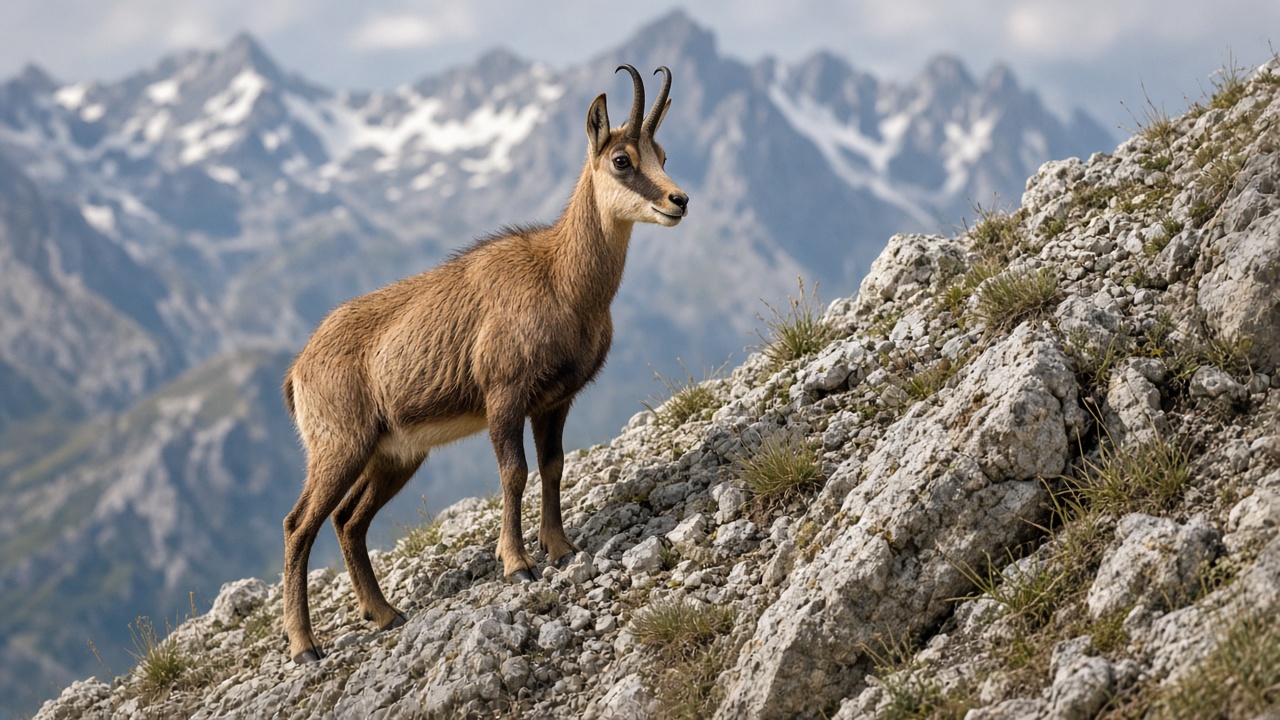
Northern Chamois
Rupicapra rupicapraNorthern Chamois (Rupicapra rupicapra): coexistence sheet across its documented range — presence, biology and prudence, without an invented hunting status.
Seen in: Austria · Bulgaria · Croatia · Czechia · France
Overview
Northern Chamois (Rupicapra rupicapra) is a coexistence sheet across its documented range: presence, biology and prudence — not a hunting status claim.
Classification: order Artiodactyla, family Bovidae, genus Rupicapra. Common names: Northern Chamois in English, Chamois in French, Rebeco alpino in Spanish.
Identification
The northern chamois weighs 25 to 50 kg and measures 110 to 135 cm in length and 70 to 80 cm at the shoulder; females are smaller than males. The coat is chestnut, paler in spring and summer; in winter, long guard hairs cover dark brown underfur. The underparts are pale and the rump white near the tail. A dark brown band runs from each side of the muzzle to the eyes and ears, while the rest of the head and the throat are white. The male’s horns rise straight up and then hook sharply back; the female’s are slimmer but can be longer.
In summer it eats mainly herbs and flowers; in winter, lichens, mosses and young pine shoots, and it can fast for two weeks when snow is too deep. Mainly diurnal, it mates between late October and December. After 170 days of gestation, a single kid of 2 to 3 kg, sometimes two or three, is born in May or June in a shelter of grass and lichens; it is weaned at 2 to 3 months and, if its mother dies, other chamois look after it. Eurasian lynx and wolves are its main predators.
Habitats and range
MDD lists it in the Alps (Austria, France, Germany, Italy, Switzerland), the Balkans, the Romanian Carpathians, the Tatras, the Caucasus (Azerbaijan, Georgia, Russia) and Turkey; it has been introduced to New Zealand. It lives in alpine and subalpine meadows above the treeline, on both steep and flatter ground. It spends the winter in forest and on steep slopes where snow does not build up.
The countries where the species’ presence is established are shown in the tags on this sheet.
Field signs
It signals danger with a whistle and by stamping its foot, then flees to the most inaccessible spots in huge leaps: almost 2 m high, at least 6 m long, and up to 50 km/h on uneven ground. Groups of females and young are seen mostly by day; adult males are solitary and aggressive during the rut.
Conservation
For conservation status of Rupicapra rupicapra, consult the current IUCN assessment, then cross with French monitoring programmes when they exist (OFB portal and related publications). Never turn a global IUCN category into a departmental hunting rule. GBIF occurrences help situate documented distribution but remain effort-biased.
The IUCN lists it as Least Concern. According to ADW, excessive hunting, habitat loss, competition with livestock and harassment by people and dogs have greatly reduced numbers in the Caucasus, the Tatras and the Chartreuse massif; elsewhere it is increasing and has been introduced or reintroduced in several parts of Europe. MDD includes the forms carpatica and asiatica, considered distinct by Groves and Grubb (2011), and treats the Pyrenean chamois as a separate species.
Limits
This sheet on the Northern Chamois covers presence and biology. A species being present in a country does not mean it may be hunted, and no season or quota is published here.
Local densities and management plans are not covered here: they are a matter for the managers of each area.
Sources
Sources consulted for this sheet:
- IUCN Red List — species search (consulted 2026-11-01)
- ASM Mammal Diversity Database — Rupicapra rupicapra (consulted 2026-11-01)
- GBIF — species search (consulted 2026-11-01)
- Animal Diversity Web — Rupicapra rupicapra (chamois) (consulted 2026-11-04)
Conclusion
In short: use the scientific name Rupicapra rupicapra to cross-check sources, confirm taxonomy and conservation status on the institutional portals listed above, and relate every field sign to the habitat where it was actually found.
Identification
Rupicapra rupicapra
Chamois · preferred
Rebeco alpino · preferred
Northern Chamois · preferred
Alpine Chamois
Balkan Chamois
Chartreuse Chamois
Tatra Chamois
Carpathian Chamois
Asia Minor Chamois
Anatolian Chamois
Turkish Chamois
Classification
Class : Mammalia
Order : Artiodactyla
Family : Bovidae
Genus : Rupicapra
Conservation
IUCN : LC
CITES : —
iucn · LC (global)
Habitat
Practices
Frequently asked questions
How do I recognise Northern Chamois?
Use Rupicapra rupicapra as the scientific anchor. The northern chamois weighs 25 to 50 kg and measures 110 to 135 cm in length and 70 to 80 cm at the shoulder; females are smaller than males. The coat is chestnut, paler in spring and summer; in winter, long guard hairs cover dark brown underfur. The underparts are pale and the r...
Where does Northern Chamois typically live?
MDD lists it in the Alps (Austria, France, Germany, Italy, Switzerland), the Balkans, the Romanian Carpathians, the Tatras, the Caucasus (Azerbaijan, Georgia, Russia) and Turkey; it has been introduced to New Zealand. It lives in alpine and subalpine meadows above the treeline, on both steep and flatter ground. It spends the winter in forest and on steep slo...
What field signs help confirm Northern Chamois?
It signals danger with a whistle and by stamping its foot, then flees to the most inaccessible spots in huge leaps: almost 2 m high, at least 6 m long, and up to 50 km/h on uneven ground. Groups of females and young are seen mostly by day; adult males are solitary and aggressive during the rut.