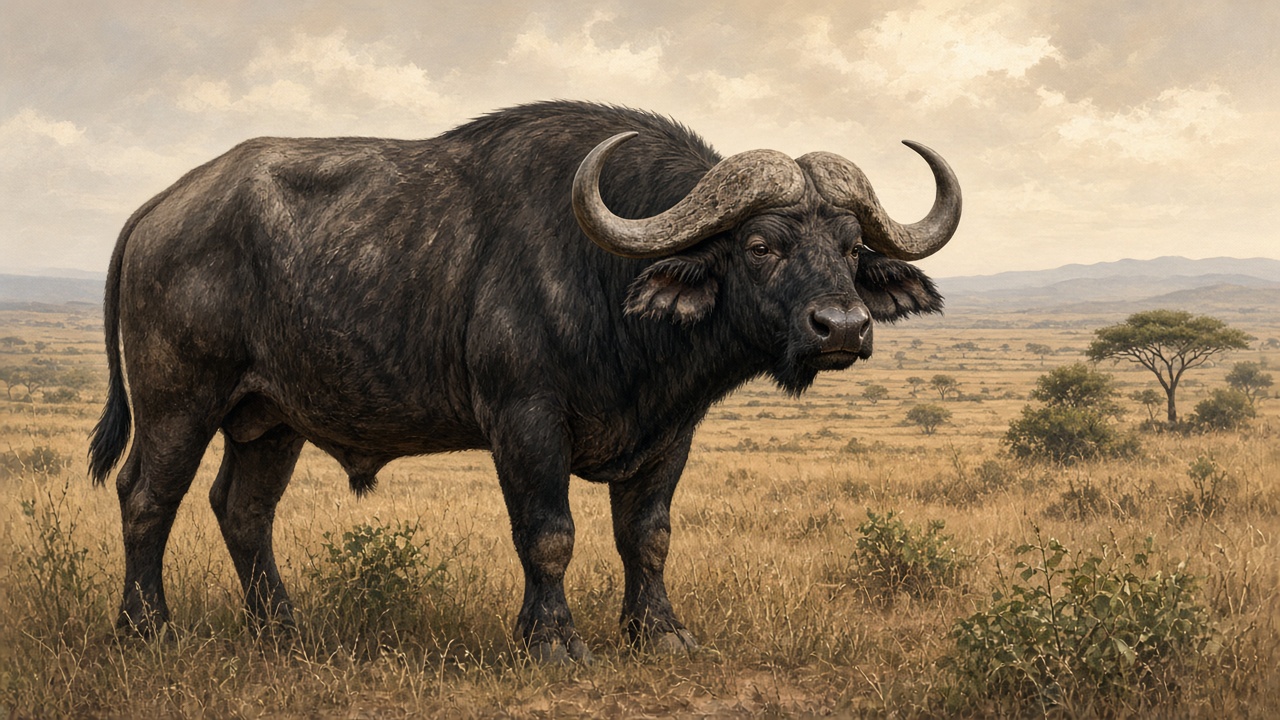
Cape Buffalo
Syncerus cafferCape Buffalo (Syncerus caffer): coexistence sheet across its documented range — presence, biology and prudence, without an invented hunting status.
Seen in: Namibia · South Africa
Overview
Cape Buffalo (Syncerus caffer) is a coexistence sheet across its documented range: presence, biology and prudence — not a hunting status claim.
Classification: order Artiodactyla, family Bovidae, genus Syncerus. Common names: Cape Buffalo in English, Buffle d'Afrique in French, Búfalo africano in Spanish.
Identification
A massive bovid with heavy, smooth horns in both sexes. In the eastern and southern savanna buffalo, males exceed 835 kg, females reach 500 kg, shoulder height is 140 to 160 cm and the horn span can reach 130 cm; the coat is dark brown to black. Males have a hump behind a thick neck, and their horns meet in a heavy boss on the forehead. The forest buffalo is much smaller (105 cm, 250 to 320 kg), often red, with backward-pointing horns and little or no boss.
Highly social, it forms large mixed herds of females and young, sometimes over a thousand strong, and small bachelor groups. A grazer, it prefers leafy grasses and sedges, then spends long periods chewing the cud; it is active by day and night, with rest periods in the early morning and late afternoon. Mating peaks at the end of the wet season; after about 340 days a single calf is born and weaned at 9 to 10 months. Lions are its main predator; leopards take calves.
Habitats and range
MDD records it in rainforest and savanna across most of sub-Saharan Africa, from Senegal to Ethiopia and south to South Africa; it is extinct in Gambia and on Bioko. It uses almost any habitat with grass and permanent water: lowland and montane forest, acacia savanna, miombo woodland, coastal savanna and semi-arid bush, up to over 4,000 m. It stays within 20 km of water, preferably within 1 km.
The countries where the species’ presence is established are shown in the tags on this sheet.
Field signs
Herds are found near water and along rivers in the dry season, often attended by oxpeckers and cattle egrets. Bulls spar by locking horns and twisting them from side to side. While resting, a few cows stand and gaze in the same direction, which the herd later follows. An uneasy buffalo stops, turns and scans its back trail for up to 80 seconds before setting off a stampede.
Conservation
For conservation status of Syncerus caffer, consult the current IUCN assessment and cross with national monitoring programmes in countries of documented presence. Never turn a global IUCN category into a local hunting rule. GBIF occurrences help situate distribution but remain effort-biased.
MDD gives its IUCN status as Near Threatened. Rinderpest, introduced in the late 19th century, decimated the species; populations have largely recovered, but habitat fragmentation and poaching for bushmeat threaten it. MDD includes the forms brachyceros, matthewsi and nanus, treated as distinct by Groves and Grubb (2011). A dangerous animal, it is also a reservoir of bovine tuberculosis that can reinfect cattle, and foot-and-mouth disease is a growing concern.
Limits
This sheet on the Cape Buffalo covers presence and biology. A species being present in a country does not mean it may be hunted, and no season or quota is published here.
Local densities and management plans are not covered here: they are a matter for the managers of each area.
Sources
Sources consulted for this sheet:
- IUCN Red List — species search (consulted 2026-11-02)
- ASM Mammal Diversity Database — Syncerus caffer (consulted 2026-11-02)
- GBIF — species search (consulted 2026-11-02)
- Animal Diversity Web — Syncerus caffer (African buffalo) (consulted 2026-11-04)
Conclusion
In short: use the scientific name Syncerus caffer to cross-check sources, confirm taxonomy and conservation status on the institutional portals listed above, and relate every field sign to the habitat where it was actually found.
Identification
Syncerus caffer
Cape Buffalo · preferred
Buffle d'Afrique · preferred
Búfalo africano · preferred
East African Buffalo
Lake Chad Buffalo
Virunga Buffalo
Mountain Buffalo
Dwarf Forest Buffalo
Red Buffalo
Forest Buffalo
Classification
Class : Mammalia
Order : Artiodactyla
Family : Bovidae
Genus : Syncerus
Conservation
IUCN : NT
CITES : —
iucn · NT (global)
Habitat
Practices
Frequently asked questions
How do I recognise Cape Buffalo?
Use Syncerus caffer as the scientific anchor. A massive bovid with heavy, smooth horns in both sexes. In the eastern and southern savanna buffalo, males exceed 835 kg, females reach 500 kg, shoulder height is 140 to 160 cm and the horn span can reach 130 cm; the coat is dark brown to black. Males have a hump behind a thick n...
Where does Cape Buffalo typically live?
MDD records it in rainforest and savanna across most of sub-Saharan Africa, from Senegal to Ethiopia and south to South Africa; it is extinct in Gambia and on Bioko. It uses almost any habitat with grass and permanent water: lowland and montane forest, acacia savanna, miombo woodland, coastal savanna and semi-arid bush, up to over 4,000 m. It stays within 20...
What field signs help confirm Cape Buffalo?
Herds are found near water and along rivers in the dry season, often attended by oxpeckers and cattle egrets. Bulls spar by locking horns and twisting them from side to side. While resting, a few cows stand and gaze in the same direction, which the herd later follows. An uneasy buffalo stops, turns and scans its back trail for up to 80 seconds before setting...