- Family
- Hunting with dogs
- Difficulty
- Moderate: the hard part is training and reading the dog, and staying calm when it is on point
- Organisation
- Often a single gun with a dog, or a small party taking turns at each point
- Key gear
- A trained dog, a whistle, a bell or beeper collar for woodland, a light gun
- Season
- Varies by species and region: check the open seasons with the local authority
- Who it suits
- Hunters who enjoy the dog work as much as the shot and do not mind walking a long way
What is the idea behind hunting over pointing dogs?
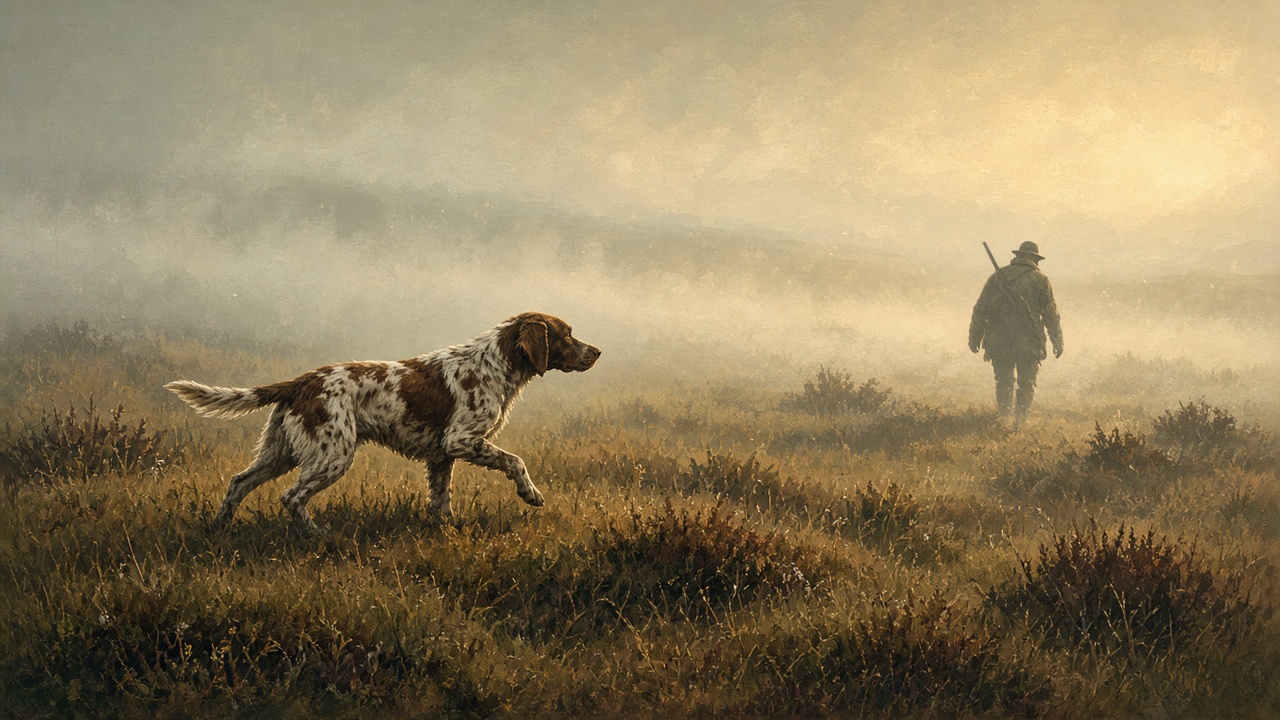
A pointing dog quarters the ground ahead of the hunter, working from side to side into the wind. When it scents a bird it stops dead: that is the point. It does not give tongue and does not chase; its job is to show where the bird is sitting tight and to hold it long enough for the hunter to come up.
The hunter walks in calmly and takes up a position that gives a clear shot, then the bird is flushed, either by the hunter or by the dog on command, depending on its training. A well-trained dog stays steady to flush and shot, and is then sent to retrieve if its training allows; many pointing dogs are expected to retrieve as well.
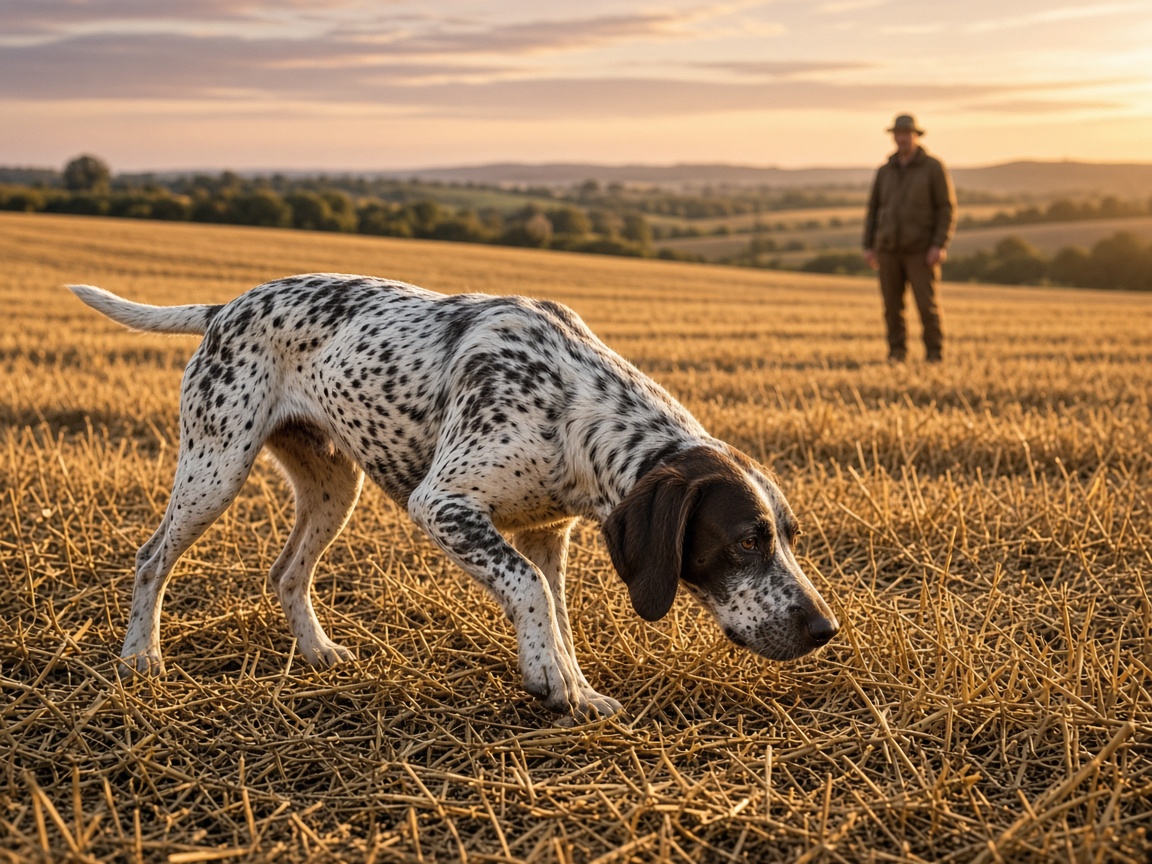
The pattern is adapted to the ground and the quarry: wide on open farmland for partridge, tighter in woodland for woodcock or pheasant. Continental breeds such as the German shorthaired pointer and the Brittany are usually distinguished from British pointers and setters, whose pace and style differ; the national kennel clubs describe the breeds and run working trials.
How does hunting over pointing dogs work in the field?
What equipment do you need for hunting over pointing dogs?
- A whistle to direct and recall the dog
- A bell or beeper collar to locate the dog in cover, as far as local rules allow
- A GPS tracking collar for dogs that range widely on open ground or the hill
- A canine first-aid kit
Safety rules for hunting over pointing dogs
- Never position yourself so that you would shoot over or towards a dog on point
- When several guns walk together, agree before the flush who shoots and on which side
- Walk up to a distant point at a steady pace with your finger off the trigger, and never run with a loaded gun
- Shoot only when you know where the dog is and it is clear of the line of fire
Common mistakes in hunting over pointing dogs
- Talking or rushing in to the point, which flushes birds too early
- Shooting a bird that flies low over the dog
- Asking a young dog to cover too much ground too soon instead of bringing it on gradually
- Working a dog that is tired, thirsty or not fit for the season
Which species are hunted by hunting over pointing dogs?
Where is hunting over pointing dogs practised?
England
In England, hunt, point and retrieve breeds (HPRs) are used mainly for walked-up shooting, and pointers and setters have their own field trials. The Royal Kennel Club licenses every field trial. When a pointing dog flushes a mammal, the Hunting Act 2004 applies: only the exempt cases in Schedule 1 are allowed.
France
In France, pointing dogs are central to walked-up shooting of partridge, pheasant, quail and woodcock. The Société centrale canine recognises the breeds and oversees working trials, including field trials. Hunting periods, quarry species and any local restrictions fall under the Environment Code and prefectoral orders.
Germany
In Germany, pointing dogs, Vorstehhunde, are assessed in the trials of the JGHV (the German working gundog federation). Its full working test, the VGP, covers work in woodland, in water and in the field, from blood tracking to pointing.
Scotland
In Scotland, pointers and setters are worked on grouse moors, and HPR breeds are used for walked-up shooting. Since 2024, red grouse may only be shot, walked-up or driven, on land covered by a NatureScot licence. The Royal Kennel Club licenses every field trial.
Western Cape (South Africa)
In the Western Cape, dogs are in principle excluded from hunting means, but CapeNature allows them for hunting birds during their open season. A hunting licence is valid only for the species listed in the province's annual hunting notice.
Spain — Castilla y León
In Spain this is called caza con perro de muestra. It is mainly used for red-legged partridge, quail and woodcock, walking up birds alone or in small groups. The RSCE recognises the breeds, including the Spanish perdiguero de Burgos, and working trials; rules are set by the autonomous communities, and regional federations inform hunters.
Rules vary by country and region: check with the local authority. See the sources
Hunting over pointing dogs compared with neighbouring techniques
Hunting over pointing dogs is a form of walked-up shooting in which the dog shows the bird instead of flushing it straight away; with a flushing breed such as the springer spaniel, the bird is put up without a point. A retriever comes in after the shot to find the bird. A scent hound follows an animal’s line giving tongue, whereas a pointing dog works in silence.
Key terms in hunting over pointing dogs
- pointing dog
- A dog that quarters ahead of the hunter and freezes when it scents a bird, to show where it is.
- quartering
- The dog’s search pattern, working from side to side ahead of the hunter.
- point
- The pointing dog’s rigid stance when it scents a bird, showing where it lies.
- walked-up shooting
- Walking the ground, often with a dog, to flush game and shoot it as it rises.
- retrieve
- The dog bringing shot game back to the handler’s hand.
- retriever
- A dog trained to find and bring back shot game to hand, on land or from water.
- scent hound
- A dog that follows an animal’s scent line while giving tongue, alone or in a pack.
- field trial
- A competition in which gundogs are judged working in the field, usually on wild game.
Frequently asked questions about hunting over pointing dogs
What is hunting over pointing dogs?
It is walked-up shooting in which a dog searches silently ahead of you and freezes on point when it scents a bird. You walk up, the bird is flushed and you shoot it as it rises.
What should you do when your dog goes on point?
Walk up calmly and quietly, without running, and place yourself so you have a clear shot away from the dog. Then flush the bird yourself or send the dog in, as its training requires.
How do continental and British pointing breeds differ?
Continental breeds such as the German shorthaired pointer and the Brittany often hunt at a steadier pace and are frequently trained to retrieve. Pointers and setters are known for a fast, wide pattern, especially on open ground.
Does a pointing dog also need to retrieve?
It is not its first job, but many hunters ask their pointing dog to retrieve as well. On bigger days, specialist retrievers may take over that work.
Which collar suits a pointing dog in woodland?
A bell or beeper collar lets you hear where the dog is and, with a beeper, when it is on point. Which devices are allowed varies from country to country.
What is a field trial for pointing dogs?
It is a working competition in which pointing dogs are judged in the field, usually on wild birds, on their quartering, their points and their steadiness. In France the SCC and breed clubs run them; in the United Kingdom, the Kennel Club.
Hunting over pointing dogs in pictures
Sources and references on hunting over pointing dogs
- Société centrale canine — Races, groupes et épreuves de travail des chiens de chasse
- Office français de la biodiversité (OFB) — Chasse, permis de chasser et police de l’environnement (consulted on )
- Légifrance — Code de l’environnement, livre IV, titre II : chasse
- Real Sociedad Canina de España (RSCE) — Razas y pruebas de trabajo de perros de caza (consulted on )
- Real Federación Española de Caza (RFEC) — Modalidades, licencias y federaciones autonómicas (consulted on )
- Boletín Oficial del Estado (BOE) — Legislación estatal y autonómica de caza (consulted on )
- The Kennel Club — Gundog breeds and field trials (consulted on )
- GWCT — Policy briefings (consulted on )
- Jagdgebrauchshundverband (JGHV) — Ordnung für die Verbandsgebrauchsprüfung (VGPO) et Verbandsprüfung nach dem Schuss (VPSO), édition 2018 (PDF) (consulted on )
- Boletín Oficial del Estado (BOE) — Ley 4/2021, de 1 de julio, de Caza y de Gestión Sostenible de los Recursos Cinegéticos de Castilla y León (texto consolidado) : arts. 32-40, 50-51 y anexo III (modalidades) (consulted on )
- Légifrance — Code de l'environnement, article L424-4 : modes de chasse (à tir, à courre, à cor et à cri, au vol) et chasse du gibier d'eau à la passée (consulted on )
- CapeNature (Western Cape Nature Conservation Board) — Guide for hunters in the Western Cape : prohibited hunting means and exceptions (dogs for birds in season and for wounded animals) (consulted on )
- The Royal Kennel Club — J Regulations (field trials) 2026, mini guide : définition du field trial, sous-groupes de chiens (consulted on )
- NatureScot — Red grouse and licensing (consulted on )
Practice information — not a legal authorisation.