- Family
- Mobile hunting on foot
- Difficulty
- Moderate: quick, instinctive shooting, long walks, managing the dog and the line
- Organisation
- Alone with a dog, or a small line of guns with one or more dogs
- Key gear
- A shotgun, a pointing or flushing dog, briar-proof clothing, a game vest with pockets
- Season
- Depends on species and country: check with the departmental federation in France, the autonomous community in Spain, and the relevant authorities and organisations in the UK (BASC, GWCT)
- Who it suits
- Hunters who enjoy walking and working with their dog and are comfortable with a shotgun
What is the idea behind walked-up hunting?
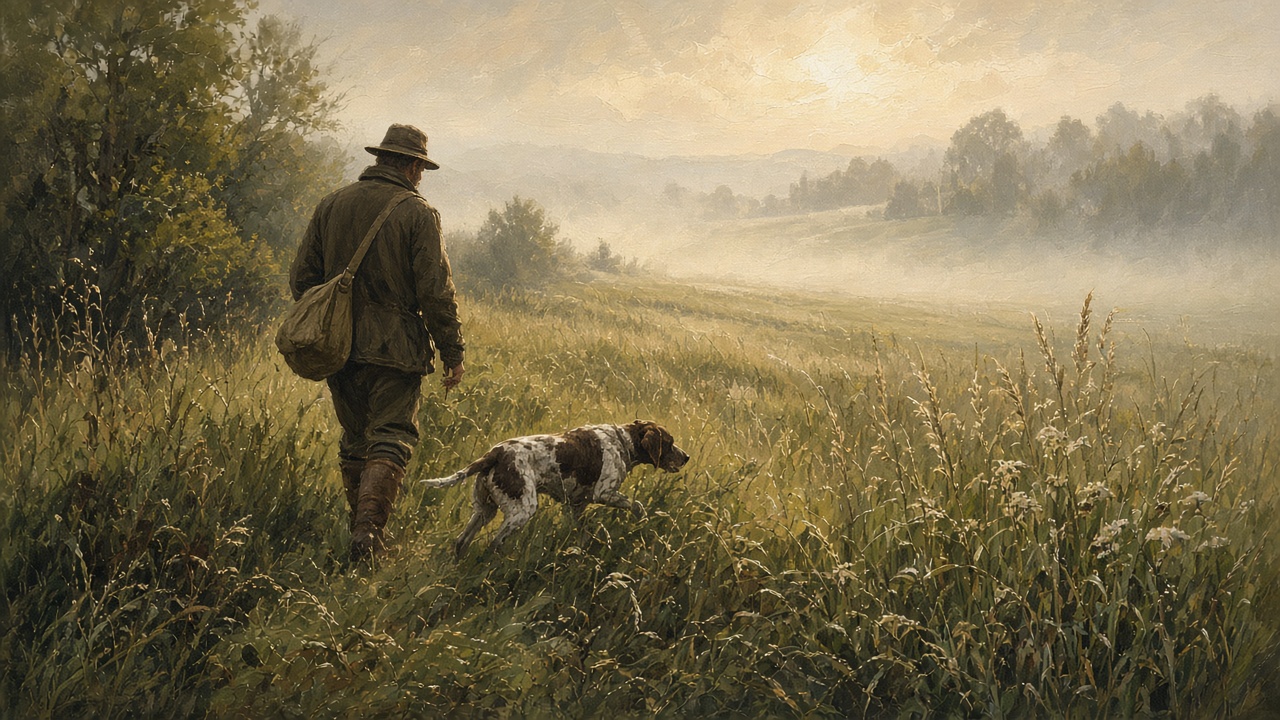
Unlike stalking, walked-up hunting does not depend on staying unseen. You walk at a steady pace, working cover, field margins and hedges, and rely on game getting up in front of you. Shooting is quick and instinctive, with a shotgun, at a hare as it bolts or a bird as it lifts.
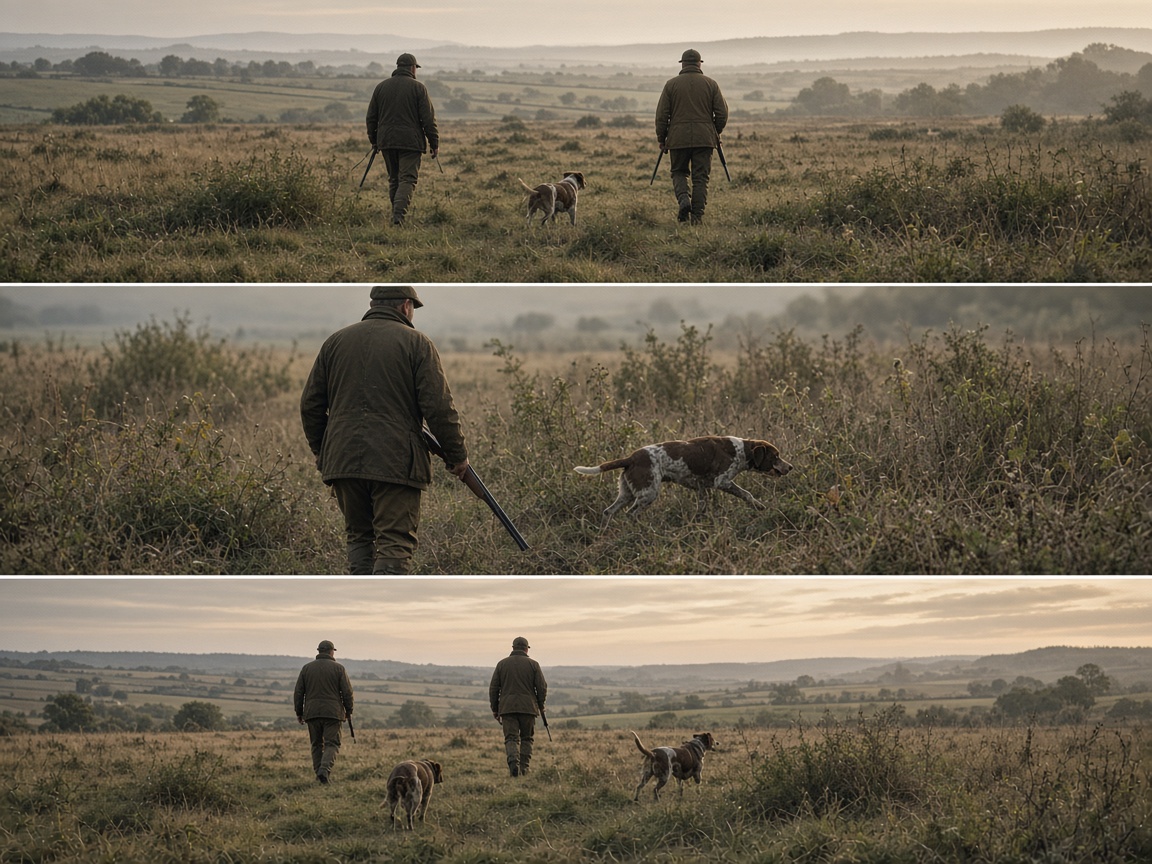
The dog does much of the work. A pointing dog quarters ahead and freezes on point when it scents a bird; the gun moves into position and the bird is then flushed. A flushing dog such as a spaniel hunts cover close in and puts game up within range. The dog often retrieves the shot game as well, which cuts losses; not every dog does, and a retriever can then join the line.
With several guns, you walk in line: everyone keeps level, at regular intervals, and knows where their neighbours are at all times. Nobody shoots along the line: only in front, within the arc agreed before setting off, and a bird that crosses behind the line is let go. Guns are opened and unloaded to cross a fence, ditch or bank. If the line bends, for example in woodland, everyone stops and straightens up before moving on.
How does walked-up hunting work in the field?
What equipment do you need for walked-up hunting?
- A light shotgun for long walks, and cartridges that meet local rules
- Reinforced trousers or gaiters against brambles and the wet, and a vest with pockets for cartridges
- A whistle and a collar that makes the dog easy to spot, plus water for it
- A knife, gloves and a bag or game bag to carry what you shoot
Safety rules for walked-up hunting
- Never shoot along the line: only in front, within the arc agreed before setting off; a bird that crosses behind the guns is let go
- Do not shoot when the dog is in the line of fire or moving into it: wait until it is clear of your arc
- Wear ear protection and shooting glasses
- Open and unload the gun at every obstacle, open it whenever you stop to talk, and carry it pointing at the sky or the ground
- Wear a brightly coloured cap or vest so your neighbours can see you in cover
- Identify the animal and what lies behind it before every shot, never a shape or a movement
Common mistakes in walked-up hunting
- Letting the line bend, so that one gun ends up ahead of or behind the others without them knowing
- Shooting a bird low as it gets up when the dog or a neighbour may be behind it
- Letting a flushing dog range too far, out of shotgun range, so that game gets up before you can shoot
- Setting out without knowing the boundaries of the ground you are allowed to hunt
Which species are hunted by walked-up hunting?
Where is walked-up hunting practised?
England
In England, walked-up shooting, or rough shooting for small informal days along hedges and ditches, is often done with a spaniel. For ground game, the Hunting Act 2004 only allows dogs in the exempt cases of Schedule 1: hunting rabbits and rats on your own land or with the occupier’s permission, or flushing to guns with no more than two dogs to prevent serious damage, to obtain meat or in a field trial, with the animal shot dead as soon as possible by a competent person. BASC publishes codes of practice on shooting and gundog work.
France
In France, walked-up hunting (chasse devant soi) is the most common way of hunting small game, often over a pointing dog such as an épagneul, braque or setter. Woodcock is closely monitored, with a bag record booklet and a national bag limit; grey partridge and wild pheasant are covered by management plans in some departments. The departmental federation and the OFB explain which species may be hunted and the local rules.
Germany
In Germany, walked-up hunting is practised notably as Buschieren: the pointing dog quarters close in front of the gun, in cover that is still fairly open, and holds small game on point. The German Hunting Association (DJV) also lists the Suche (searching with a dog) among the methods distinct from driven hunting.
Portugal
Salto (walked-up hunting) is a legal method. Outside managed hunting areas, a line has at most five hunters and lines keep 150 m apart.
Scotland
In Scotland, walked-up shooting takes place on farmland and on the moor. The Hunting with Dogs (Scotland) Act 2023 allows no more than two dogs, kept under control, to search for or flush a wild mammal to be shot, with the landowner’s permission, and the animal must be shot as soon as reasonably possible (section 6).
Western Cape (South Africa)
In the Western Cape, CapeNature lists dogs among prohibited hunting means but allows them for hunting birds in their open season and for searching for a wounded animal. Hunting protected species requires a licence and follows the province's annual hunting notice; other provinces set their own rules.
Spain — Castilla y León
In Spain, caza al salto means one hunter or a few, with or without a dog; when several hunters walk together in line it is called caza en mano. It targets red-legged partridge, rabbit and hare, and woodcock is hunted over pointing dogs in the northern woods. Each autonomous community sets species, periods and methods; the regional hunting federation can advise.
Rules vary by country and region: check with the local authority. See the sources
Walked-up hunting compared with neighbouring techniques
Walked-up hunting is mobile like stalking, but differs in every other way: small game instead of big game, a shotgun instead of a rifle, a quick shot at game breaking cover instead of a steady shot at a chosen animal. Hunting over pointing dogs is a specialised form of it, where the dog’s point sets the pace. Driven game-bird shooting is the reverse: the guns stay put and beaters bring the birds to them.
Key terms in walked-up hunting
- walked-up shooting
- Walking the ground, often with a dog, to flush game and shoot it as it rises.
- pointing dog
- A dog that quarters ahead of the hunter and freezes when it scents a bird, to show where it is.
- quartering
- The dog’s search pattern, working from side to side ahead of the hunter.
- retriever
- A dog trained to find and bring back shot game to hand, on land or from water.
- retrieve
- The dog bringing shot game back to the handler’s hand.
- flushing dog
- A dog such as a spaniel that hunts cover close to the gun and flushes game within shotgun range.
- walking in line
- Several guns walking the ground abreast, at regular intervals, to flush game ahead of them.
- broken gun
- A shotgun opened at the hinge so that everyone can see it cannot fire.
Frequently asked questions about walked-up hunting
What is walked-up hunting?
It is hunting small game on foot: you cover the ground, usually with a dog, to flush hares, rabbits or birds and shoot them with a shotgun.
Do you need a dog for walked-up hunting?
Not strictly, but a dog finds far more game than a hunter alone and, if trained to retrieve, recovers what is shot, especially in thick cover.
Pointing dog or flushing dog?
A pointing dog marks the bird and lets the gun get into position; it suits open farmland and moorland. A flushing dog works brambles and puts game up close; it suits dense cover.
How do you walk in line safely?
Keep level with your neighbours, shoot only in front and never along the line, open and unload the gun at every obstacle and stop to straighten up as soon as the line bends.
How does it differ from stalking?
Stalking targets a big-game animal already spotted, approached quietly and shot carefully with a rifle. Walked-up hunting targets small game that gets up, shot with a shotgun, and accepts the noise of walking.
Can you hunt woodcock walked-up?
Yes, it is one of the most common ways, often over a pointing dog in woodland. In France woodcock bags are recorded in a booklet; rules vary from country to country.
Walked-up hunting in pictures
Sources and references on walked-up hunting
- Office français de la biodiversité (OFB) — Chasse, permis de chasser et police de l’environnement (consulted on )
- Fédération nationale des chasseurs (FNC) — Chasseur de France : pratiques, sécurité et fédérations départementales (consulted on )
- Légifrance — Code de l’environnement, livre IV, titre II : chasse
- Société centrale canine — Races, groupes et épreuves de travail des chiens de chasse
- Boletín Oficial del Estado (BOE) — Legislación estatal y autonómica de caza (consulted on )
- Real Federación Española de Caza (RFEC) — Modalidades, licencias y federaciones autonómicas (consulted on )
- Real Sociedad Canina de España (RSCE) — Razas y pruebas de trabajo de perros de caza (consulted on )
- British Association for Shooting and Conservation (BASC) — Shooting advice and codes of practice (consulted on )
- Game & Wildlife Conservation Trust (GWCT) — Game and wildlife research (consulted on )
- The Kennel Club — Gundog breeds and field trials (consulted on )
- Deutscher Jagdverband (DJV) — Sonstige Jagdarten : Buschieren, Lappjagd (consulted on )
- Boletín Oficial del Estado (BOE) — Ley 4/2021, de 1 de julio, de Caza y de Gestión Sostenible de los Recursos Cinegéticos de Castilla y León (texto consolidado) : arts. 32-40, 50-51 y anexo III (modalidades) (consulted on )
- Légifrance — Arrêté du 31 mai 2011 relatif au prélèvement maximal autorisé de la bécasse des bois (consulted on )
- Procuradoria-Geral Distrital de Lisboa — Decreto-Lei n.º 202/2004, de 18 de agosto (versão consolidada, DL 71/2024) : art. 84.º, 86.º, 88.º, 90.º (consulted on )
- CapeNature (Western Cape Nature Conservation Board) — Guide for hunters in the Western Cape : prohibited hunting means and exceptions (dogs for birds in season and for wounded animals) (consulted on )
- legislation.gov.uk — Hunting Act 2004, Schedule 1 : Exempt hunting (paras 1 à 9) (consulted on )
- legislation.gov.uk — Hunting with Dogs (Scotland) Act 2023, section 6 : exception, fauconnerie, tir du gibier et deer stalking (consulted on )
Practice information — not a legal authorisation.