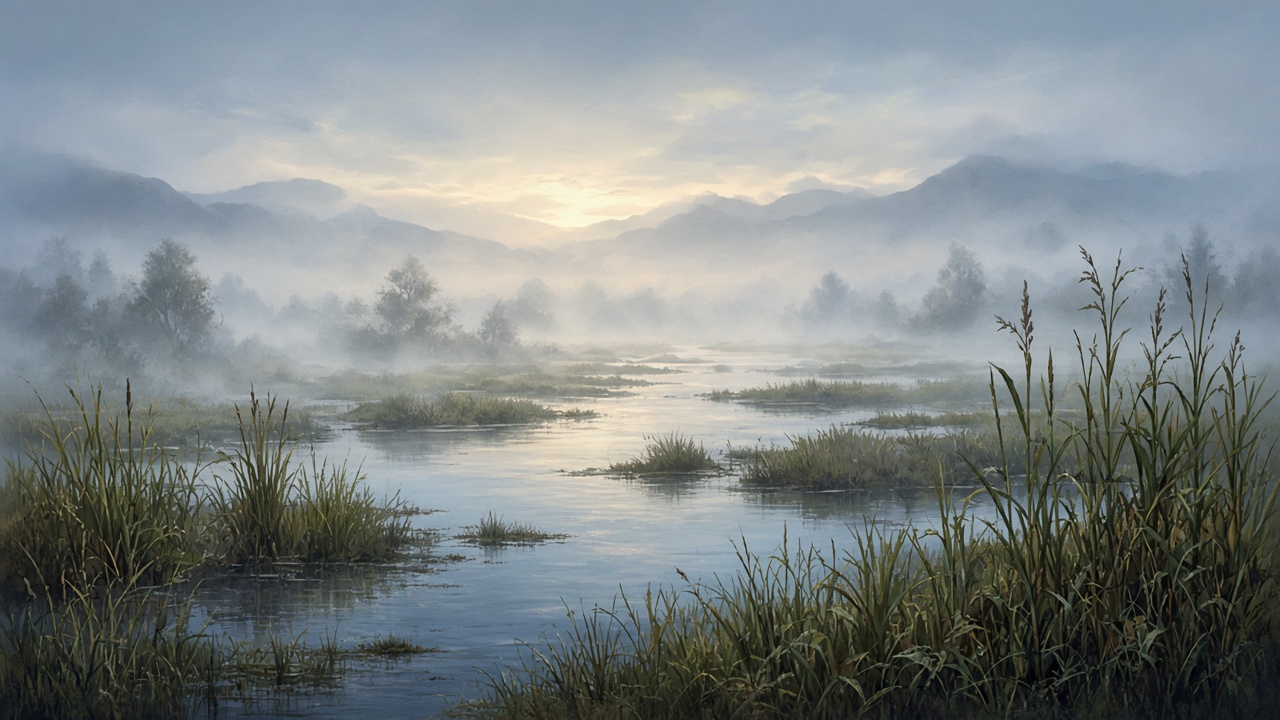
- Treeless freshwater marshes dominated by reeds, cattails, sedges and rushes, in a mosaic with open water.
- Two main regimes: permanent marshes with stable water levels and seasonally flooded marshes.
- Peatlands, rivers and lakes, and coastal saltmarshes each have their own sheet.
- Drainage, conversion to farmland and eutrophication are the main threats.
Definition and boundaries
The Ramsar Convention gives the word “wetland” a very broad meaning, from lakes to rice paddies. This sheet is limited to freshwater marshes: permanent marshes (group TF1.3 of the IUCN typology) and seasonal floodplain marshes (TF1.4). Peatlands, rivers and lakes, and saltmarshes are covered in the Peatlands, Aquatic habitats and Coastal habitats sheets.
Distribution
Permanent marshes are scattered across all tropical and temperate regions; floodplain marshes cover the seasonal tropics and subhumid temperate regions. Examples include the ponds and marshes of the Brenne and Dombes in France, the Danube delta, the Pantanal in Brazil, the Okavango delta in Botswana and the Florida Everglades.
Climate
Local climate matters less than water supply. Permanent marshes stay flooded thanks to frequent floods and nearby lakes, sometimes independently of local rainfall. Floodplain marshes instead follow river regimes, themselves driven by rainfall or snowmelt in the catchment; their extent varies strongly from year to year.
Soils, relief and water
These marshes occupy flat ground and depositional settings: lake shores, groundwater seeps, alluvial floodplains and deltas. Soils, often organic, are saturated and low in oxygen, which slows decomposition. Silts and clays supply plenty of nitrogen and phosphorus. Salinity is low except near brackish lagoons.
Structuring vegetation
Vegetation is emergent and treeless: extensive common reed beds, cattails, bulrushes, sedges and rushes, often in near-pure stands. These plants have hollow stems that carry oxygen down to the roots. Floating plants, algae and phytoplankton complete a very high primary production.
Characteristic fauna
Invertebrates are abundant and feed herons, ducks, rails and waders, which nest in the vegetation. Among mammals, the water vole in Europe, the muskrat in North America, the water deer in East Asia, the marsh deer in the Pantanal, and the sitatunga, kob and hippopotamus in Africa are closely tied to these marshes. The muskrat, introduced to Europe in the 20th century, is a non-native species there.
Functioning and dynamics
In floodplain marshes, receding water concentrates prey in the last pools, attracting predators and waterbirds. Many plants and invertebrates survive drought as dormant seeds or eggs. Surface fires can burn vegetation in the dry season without reaching the saturated soil of permanent marshes.
Threats
Drainage for farming or urban development, river regulation that removes floods, and eutrophication from fertilisers are the major pressures. Introduced species, such as coypu or muskrat outside their native range, damage banks and vegetation.
Field reading
Water level governs everything: it opens or closes feeding areas and moves birds from one day to the next. Wind over open water steers flight lines and resting places. Runs through the reeds, vole feeding stations and tracks in the mud show which animals are present. The ground can give way without warning.
This sheet describes a habitat. It publishes no season, quota or hunting authorisation: those rules must be checked with the competent authorities of the territory concerned.
Documented gaps
- Swamp forests (alder carr, cypress swamps) are not described here.
- No figures on wetland area lost by region.
- Waterbird migration is only mentioned in general terms.
Sources
- IUCN Global Ecosystem Typology — TF1.3 Permanent marshes (consulted 2026-11-04)
- IUCN Global Ecosystem Typology — TF1.4 Seasonal floodplain marshes (consulted 2026-11-04)
- Convention on Wetlands (Ramsar) — The Convention on Wetlands and its mission (consulted 2026-11-04)
Related species
Related techniques
Practice information — not a legal authorisation.
Frequently asked questions
What is the difference between a marsh and a peatland?
In a marsh, little organic matter accumulates and vegetation is dominated by reeds and sedges on rich soils. In a peatland, peat builds up on acid, nutrient-poor soils, often under sphagnum mosses.
Why is the falling flood a key moment?
As water drops, fish and invertebrates concentrate in the remaining pools. Herons, storks and predators take advantage of this easy prey.
Is a Ramsar-listed wetland covered by a single rule?
No. Listing commits the State to sustainable management of the site, but rules of use depend on national and local law.
Does this sheet authorise hunting in this habitat?
This sheet describes a habitat. It publishes no season, quota or hunting authorisation: those rules must be checked with the competent authorities of the territory concerned.
Gallery
Keep exploring
Connect this environment to documented species, techniques and other habitats — without confusing ecological description with hunting authorisation.