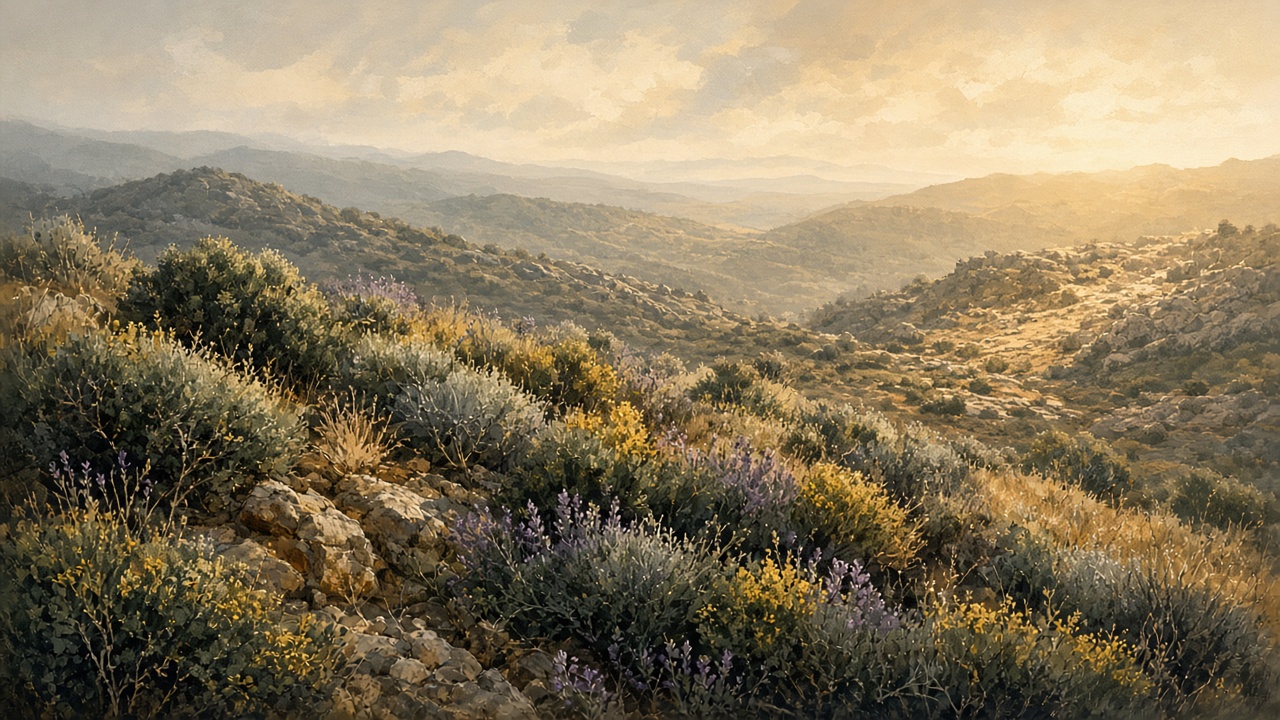
- Garrigue is low and open, on dry, stony limestone soils.
- Maquis is tall and dense, on siliceous soils derived from granite or schist.
- Both are adapted to summer drought and regrow after fire.
- They are often stages in the degradation or recovery of Mediterranean forest.
Definition and boundaries
Garrigue and maquis are formations of evergreen, hard-leaved shrubs, placed by the IUCN among seasonally dry temperate heaths and shrublands (group T3.2). Garrigue stays low, often under one metre, and leaves the rock visible; maquis forms a closed thicket that can exceed head height. Mediterranean forest has its own sheet.
Distribution
Both formations ring the Mediterranean: garrigue in Languedoc, Provence, the Balearics and Greece; maquis in Corsica, Sardinia, the Maures and Esterel hills, Andalusia and North Africa. Comparable scrublands exist in other Mediterranean-climate regions: Californian chaparral, Chilean matorral and South African fynbos.
Climate
The Mediterranean climate combines hot, dry summers with mild winters that bring most of the rain. Summer drought, often accompanied by strong winds such as the mistral or tramontane, dries out vegetation and creates a high fire risk. Autumn storms can be violent.
Soils, relief and water
The difference lies first in the rock. Garrigue grows on limestone: thin, stony, dry soils with exposed bedrock slabs. Maquis occupies acid, siliceous soils derived from granite, gneiss or schist, which are deeper and hold water better, allowing taller vegetation.
Structuring vegetation
Garrigue is dominated by kermes oak, rosemary, thyme, rockroses, prickly juniper and lavenders, with many orchids in spring. Maquis brings together tree heath, strawberry tree, myrtle, mastic, phillyrea and Montpellier rockrose, often beneath scattered holm or cork oaks.
Characteristic fauna
Wild boar find cover and plentiful acorns in maquis; European rabbit and red-legged partridge prefer open garrigue. The Iberian hare lives in the matorral of the Iberian Peninsula; the Italian hare (also called Corsican hare), native to peninsular Italy and Sicily, was introduced to Corsica. Red fox, genet and stone marten hunt in both. The Iberian ibex uses rocky matorral in the sierras, Corsican mouflon the upland maquis. Reptiles and insects are abundant on the warm soils of garrigue.
Functioning and dynamics
Garrigue and maquis often result from the degradation of Mediterranean oak forest by fire, cutting and grazing. Most of their shrubs resprout from the stump or germinate after fire. Without further fire or grazing, maquis develops into holm oak forest; garrigue closes over more slowly for lack of soil.
Threats
Fires that are too frequent stop vegetation from recovering and encourage erosion. Conversely, the abandonment of grazing closes garrigue and removes open-ground species. Scattered urban growth on the edges of the hills increases both the number of fire outbreaks and the damage they cause.
Field reading
In maquis, visibility is poor and animals follow narrow runs beneath the shrubs; in garrigue you can see far, but animals blend into the clumps. Boar wallows and rooting mark busy areas. In summer, check access to the hills, which is often restricted because of fire risk.
This sheet describes a habitat. It publishes no season, quota or hunting authorisation: those rules must be checked with the competent authorities of the territory concerned.
Documented gaps
- Scrublands of other Mediterranean-climate regions (chaparral, fynbos) are only mentioned.
- No figures on burned areas.
- Garrigue reptiles and birds are not linked to species sheets.
Sources
- IUCN Global Ecosystem Typology — T3.2 Seasonally dry temperate heath and shrublands (consulted 2026-11-04)
- IUCN Global Ecosystem Typology — T2.6 Temperate pyric sclerophyll forests and woodlands (consulted 2026-11-04)
Related species
Related techniques
Practice information — not a legal authorisation.
Frequently asked questions
How do you tell garrigue from maquis?
By rock and height: garrigue is low and open on limestone, maquis is tall and dense on siliceous soils.
Why do these habitats burn so easily?
The shrubs are rich in aromatic oils and very dry in summer, and strong winds spread fire quickly.
Will garrigue turn back into forest?
Slowly, if fire and grazing stop. On very thin limestone soils, however, it can stay open for a long time.
Does this sheet authorise hunting in this habitat?
This sheet describes a habitat. It publishes no season, quota or hunting authorisation: those rules must be checked with the competent authorities of the territory concerned.
Gallery
Keep exploring
Connect this environment to documented species, techniques and other habitats — without confusing ecological description with hunting authorisation.