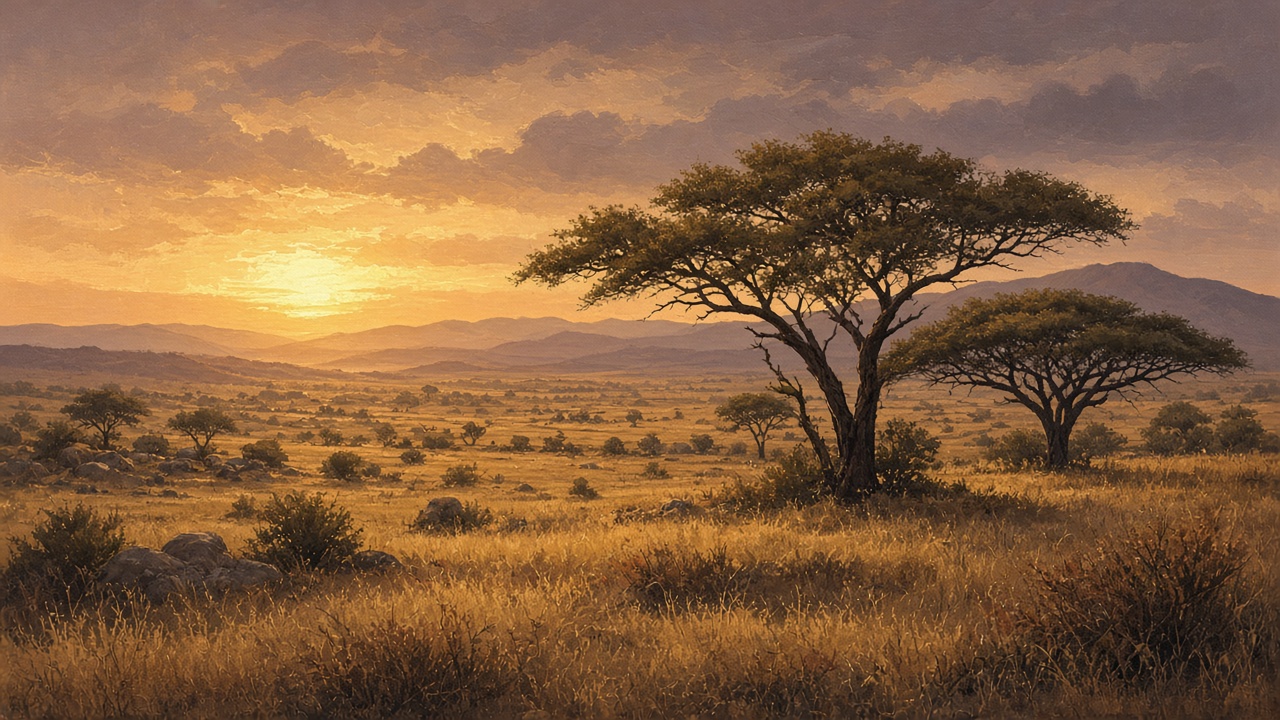
South Africa — hunting and nature
Bushveld, Karoo, fynbos: not the Namibian list.
Overview
South Africa does not shrink to the bushveld. The Karoo, Cape fynbos, the Drakensberg, the Highveld and the iSimangaliso coast change the large fauna before they change province.
The Drakensberg closes the mountainous east. The Karoo spreads the dry interior. The Lowveld and Kruger carry the bushveld. Fynbos of the Western Cape is not that acacia plain.
Habitats
Bushveld enters the savanna code. The Karoo is arid. Fynbos links to heath, not to savanna. Drakensberg mountain, Highveld grassland, coast, wetland and montane forest complete South Africa.
Fauna followed on this sheet
Kudu, eland, buffalo, springbok, impala and wildebeest are read with the bushveld, the Highveld and the Cape. Lion and leopard have their place on the large grounds. This South African list must not be treated as identical to Namibia’s, which is read from the Namib and not from the fynbos.
How the country is read
A walk-up safari and a watch at a waterhole structure the South African reading, with no fee and no calendar on this page. Fynbos is not the ground of that lowland approach.
What this sheet does not state
The South African sheet publishes no season, quota, fee or weapon authorisation. The dated national or provincial text governs for Kruger as for the Karoo.
Sources
Institutional pages consulted for South Africa. Open the live page before any operational use.
- Department of Forestry, Fisheries and the Environment (DFFE) (consulted 2026-11-02)
- GBIF — country ZA (consulted 2026-11-02)
Before a field reading
For South Africa, name the biome. Fynbos, the Drakensberg and Lowveld bushveld do not replace one another, and none of the three is Etosha.
Habitats
Species
Documented presence at country level, with its status. No inheritance down to municipalities. Presence is not an authorisation.
Native
-
Aardvark
Orycteropus afer
-
African Civet
Civettictis civetta
-
African Savanna Elephant
Loxodonta africana
-
African Savanna Hare
Lepus microtis
-
Blue Duiker
Philantomba monticola
-
Bush Duiker
Sylvicapra grimmia
-
Bushpig
Potamochoerus larvatus
-
Cape Buffalo
Syncerus caffer
-
Cape Hare
Lepus capensis
-
Caracal
Caracal caracal
-
Cheetah
Acinonyx jubatus
-
Common Eland
Tragelaphus oryx
-
Common Genet
Genetta genetta
-
Common Hippopotamus
Hippopotamus amphibius
-
Common Warthog
Phacochoerus africanus
-
Egyptian Mongoose
Herpestes ichneumon
-
Greater Cane Rat
Thryonomys swinderianus
-
Greater Kudu
Tragelaphus strepsiceros
-
Hartebeest
Alcelaphus buselaphus
-
Honey Badger
Mellivora capensis
-
Klipspringer
Oreotragus oreotragus
-
Leopard
Panthera pardus
-
Lion
Panthera leo
-
Oribi
Ourebia ourebi
-
Plains Zebra
Equus quagga
-
Roan Antelope
Hippotragus equinus
-
Rock Hyrax
Procavia capensis
-
Serval
Leptailurus serval
-
Side-striped Jackal
Lupulella adusta
-
Smith's Bush Squirrel
Paraxerus cepapi
-
South African Ground Squirrel
Geosciurus inauris
-
Spotted Hyena
Crocuta crocuta
-
Tsessebe
Damaliscus lunatus
-
Waterbuck
Kobus ellipsiprymnus
Introduced
-
Roof Rat
Rattus rattus
Techniques
Technique page for this countryNeighbouring countries
Frequently asked questions
What does the South Africa sheet cover on Aunerys?
Bushveld, Karoo, fynbos: not the Namibian list.
Does this sheet state seasons, quotas or fees?
The South African sheet publishes no season, quota, fee or weapon authorisation. The dated national or provincial text governs for Kruger as for the Karoo.
Do listed species mean hunting is allowed?
Documented presence with a status is not an authorisation. National or regional rules decide what is lawful.